Rules and law
ID blocked unfairly? Grievance options for platform workers in 2026
What you can do in Delhi NCR when a delivery app blocks your ID: the app's own channels and how to use them, the rules for bike-taxi apps, your rights under the data protection law, what the social security code covers, and what Delhi's gig workers have asked for.
By Editorial team Published
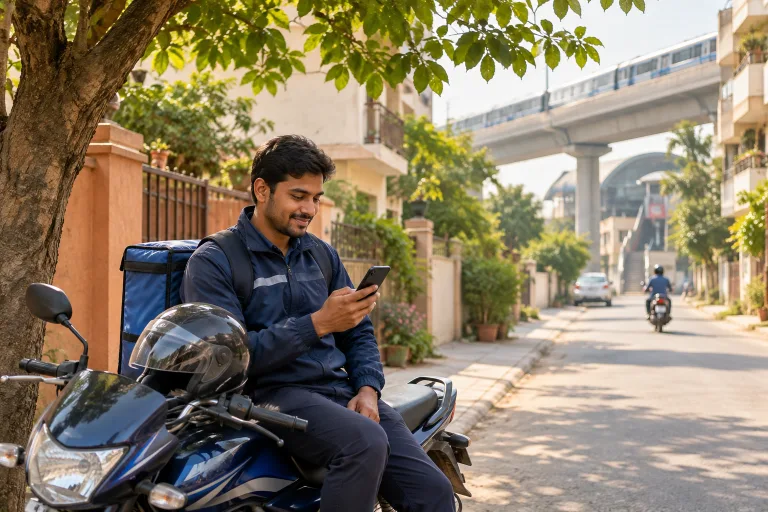
If a delivery app blocks your ID and you believe it's a mistake, the app's own support is still your first and main route in November 2026. The Code on Social Security, which recognises gig and platform workers, doesn't set up an appeal against a blocked ID: its grievance and helpline sections deal with social security schemes and registration. A Delhi law with its own appeal system has so far only been proposed by workers' groups. This post covers each route that does exist, who it is for, and how to make your complaint count.
| Route | Who it's for | What it covers | Source |
|---|---|---|---|
| App support and escalation | Every delivery partner | Penalties, ratings, ID blocks, payouts | Fairwork India Ratings 2024 |
| Grievance officer of a ride app | Bike-taxi Captains and drivers | Any driver grievance | MoRTH guidelines 2025, clause 9.10 |
| Data grievance, then the Data Protection Board | Anyone whose data an app holds | Wrong or misused personal data | DPDP Act 2023, section 13 |
| e-Shram helpline 14434 | Gig and platform workers | Registration and scheme questions | e-Shram FAQ |
Step 1: use the app's own channel, and climb it
In its 2024 review of 11 platforms, the Fairwork India team credited seven (Amazon Flex, bigbasket, BluSmart, Flipkart, Swiggy, Urban Company and Zomato) with due process and real channels to appeal penalties, low ratings and ID blocks: ticketing, chat and call-back options that reach a human representative in regional languages, open to deactivated workers too. Some had added a way to escalate to a fleet or hub manager when the call centre didn't help (Fairwork India Ratings 2024, October 2024).
The catch, as the IIT Madras study heard from workers and others in the sector: since COVID-19, chatbots have become the main complaint channel, there are fewer company staff on the ground, and complex cases such as unfair deductions or a sudden account suspension hit a wall. Workers asked for a system where such cases move up to a human (IIT Madras CeRAI study, September 2025).
How to make your complaint count:
- Write down the facts first: the date and time the ID stopped working, the exact message on screen and your partner ID number. Take screenshots.
- Raise a ticket and keep its number. Ask for the specific reason for the block and the order or date it relates to.
- Ask for a person. If the chatbot repeats itself, ask for a call-back or an agent, and ask whether your hub or fleet manager can look at it.
- Ask about your money. Ask when the payout for orders you already completed will reach you.
- Keep it in writing. Follow up on the same ticket, so the record stays in one place.
Step 2 for bike-taxi Captains: the grievance officer
Ride apps fall under the central Motor Vehicle Aggregator Guidelines 2025, which states may adopt. They ask each app to appoint a Grievance Officer to resolve the grievances of passengers and drivers, to show the officer's name, email and phone number in the app and on its website, and to report the grievances it receives to the licensing authority online (clause 9.10). If a passenger complains about a driver, the app must complete an inquiry within 3 days and act only after it (clause 11.2(vi)) (MoRTH guidelines 2025, read October 2026). Look for the grievance officer's details in your Captain app before you need them.
Step 3 if the problem is your data
If the block comes from wrong data, such as a name that doesn't match your licence or a selfie the system won't accept, the Digital Personal Data Protection Act gives you a right to a grievance channel from the app (section 13). You must use that channel before you can go to the Data Protection Board (DPDP Act 2023). The Rules allow an app up to 90 days to answer (DPDP Rules 2025, rule 14), but none of this binds apps until eighteen months after the law was notified in November 2025 (Act commencement notice, G.S.R. 843(E), 13 November 2025). Details: your data on delivery apps.
What the social security code does and doesn't cover
The Code on Social Security, 2020 recognises gig and platform workers. Its section on them (section 114) is about welfare schemes, how they are funded, and a national board on which gig and platform workers get five seats. Section 112 lets governments set up helplines and facilitation centres that give information on schemes and help with registration and enrolment. The one grievance clause nearby (section 109(4)) covers grievances under schemes for unorganised workers (Code on Social Security, 2020, PRS copy). None of these is an appeal against a blocked ID.
A block can still touch your social security. Under the Social Security (Central) Rules, 2026, notified on 8 May 2026, a day counts only if you earned on the app that day, you need 90 days with one app or 120 days across apps in the last financial year to stay eligible for the schemes, and apps must report on the government portal when a worker exits (Gazette, G.S.R. 344(E), rules 48 and 49). For registration problems, the e-Shram helpline is 14434 (e-Shram FAQ, read October 2026). How to register and what is open now: e-Shram and social security for riders.
What Delhi's gig workers have asked for
Delhi's Budget 2026-27 announced a separate welfare board for gig workers (PRS India's analysis of the Delhi budget 2026-27). In January 2026 a delegation from the Gig Workers Association met Chief Minister Rekha Gupta with a draft Delhi Platform-Based Gig Workers (Registration and Welfare) Bill. It proposes a statutory grievance and appeal mechanism, advance notice before changes to algorithms or incentives that affect earnings, tracking of payments and deductions, and penalties for platforms that don't comply. At that meeting no timeline was fixed (Business Standard, 24 January 2026). Until a law passes, these are proposals, not rights you can use.
While you wait, keep your phone number and bank account unchanged so messages and money still reach you, and don't sign up again under someone else's name (see renting or borrowing an ID).
What decides whether an ID stays active in the first place: ratings, refused orders and blocked IDs.
Looking for delivery work?
Fill in one short form with your name, phone, city and area.