On the job
Ratings, rejected orders and blocked IDs: what decides whether you keep working (Delhi NCR, 2026)
Delivery apps watch more than your order count: refusals, customer ratings and complaints, login habits, selfie checks and fraud flags. What reporters and researchers found, and where you can complain if your ID is blocked.
By Editorial team Published
Whether your delivery ID stays active is decided mostly by the app itself: by its partner terms and by how its system reads your record. Reporters and researchers who looked closely found the same few things counting again and again: the orders you refuse, customer ratings and complaints, how regularly you log in, selfie checks, and signs of fraud. The Code on Social Security, which recognises gig and platform workers, doesn't lay down how an app must handle a blocked ID, and a Delhi law for gig workers is still only a proposal (details below). This guide brings together what is on record, with a source and a month for every point, and shows where you can raise a complaint today.
What the apps keep score of
A study by IIT Madras's Centre for Responsible AI interviewed 16 gig workers and 21 other people from the sector, with fieldwork in Delhi NCR and Bengaluru. It lists the measures platforms use to judge a worker: login-logout consistency, customer ratings, complaints (above all about delays and delivery problems), order acceptance rate and travel efficiency (IIT Madras CeRAI study, September 2025, posted June 2026).
An earlier review of 11 platforms by the Fairwork India project found the same link: even before slots became common, a worker's earnings were tied to on-time delivery, completed gigs, being available at peak times and customer ratings (Fairwork India Ratings 2024, October 2024).
| What can count against your ID | What was reported | Source | Read more |
|---|---|---|---|
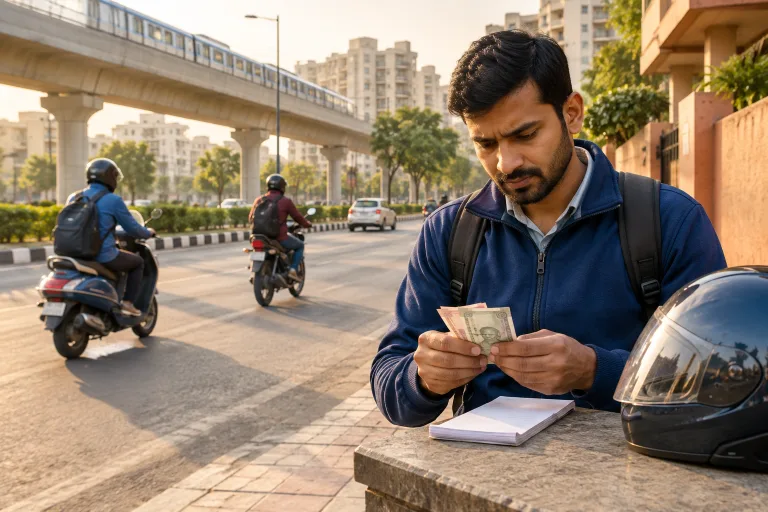
| Refusing orders | A reporter in Delhi refused four Swiggy orders: three of the refusals cost ₹30 each, and the fourth left his account shut till the following day | Indian Express, January 2026 | Penalties for turning down orders |
| Customer ratings and complaints | Zomato's CEO said partners are removed only when the same complaint keeps coming back, and an internal "karma score" is used in disputes | Outlook Business, January 2026 | How customer ratings affect you |
| Selfie checks | Platforms run periodic selfie checks to confirm that the registered worker is doing the work and wearing the uniform | IIT Madras CeRAI, September 2025 | Selfie checks at login |
| Someone else using your ID | The same study heard that some workers share their login with others; one said a friend sometimes works on his ID | IIT Madras CeRAI, September 2025 | Renting or borrowing an ID |
| Fraud | Zomato removes roughly 5,000 partners a month for fraud, such as marking an order delivered without handing it over | Storyboard18, January 2026 | This page, below |
| Protests | An interviewee told the IIT Madras team that some IDs were deactivated after workers raised concerns or joined protests | IIT Madras CeRAI, September 2025 | This page, below |
Refusing orders
On some apps, saying no to an order costs money straight away. The Indian Express reporter who worked one day each on Swiggy, Zomato and Blinkit in Delhi earned ₹114 for 6 Swiggy deliveries, an amount cut down by refusal penalties. Zomato charged him nothing for refusals but paused his account for 15 minutes, and Blinkit didn't fine him (Indian Express, 14 January 2026). The full account, and what to find out before you press reject, is in our post on penalties for turning down orders.
How refusals, incentives and deductions fit into your pay overall: pay and incentives guide.
Ratings and complaints
On Zomato at least, one bad rating is not what ends an ID. Zomato's CEO, Deepinder Goyal, said on a podcast that the company checks each complaint but acts only when the same issue keeps coming up, and that in about 50 to 70% of disputed cases it refunds the customer while the partner keeps working (Outlook Business, 6 January 2026). A pattern of complaints, though, is what gets an account removed. More on this, including the rule for bike-taxi apps: how customer ratings affect a delivery partner.
Selfie checks and shared IDs
The selfie the app asks for is there to match your face with the person who passed the background check. The IIT Madras study found these checks are not always right: one worker sent a selfie wearing the company T-shirt and was still penalised for not wearing it (IIT Madras CeRAI, September 2025). Read why apps check your face and why letting someone else ride on your ID is a bad deal.
Fraud and cash
The removals Zomato's CEO described were mostly for two things: orders marked delivered that the customer never got, and cash-on-delivery orders where the rider said he had no change, promised to come back and didn't (Outlook Business, 6 January 2026; Storyboard18, 5 January 2026). Mark an order delivered only after it is in the customer's hands, and settle cash on the spot. If you carry cash-on-delivery orders, read cash on delivery: staying safe and spotting fake notes.
Protests and switching off
Going offline in a strike carries its own risk. The Indian Express report says most delivery workers can't afford to join protests because they would lose a day's pay and could be banned (Indian Express, January 2026). During its Delhi fieldwork the IIT Madras team watched quick-commerce workers switch off their IDs over a pay cut; the company raised payouts and the strike ended (IIT Madras CeRAI, September 2025).
If your ID is blocked: where you can complain
There is no single office for this yet. The routes that exist in November 2026:
- The app's own support. Seven of the 11 platforms Fairwork reviewed in 2024, Swiggy and Zomato among them, showed ticket, chat or call-back channels where a person answers, even after an ID is deactivated; some also let you take a case to a fleet or hub manager (Fairwork India Ratings 2024). Workers in the IIT Madras study said chatbots struggle with penalties, deactivations and payouts, and asked for a time-bound way to reach a person (IIT Madras CeRAI, September 2025).
- Bike-taxi apps. Ride apps come under central guidelines from 2025 that each state can take up. They ask every ride app to name a grievance officer for passengers and drivers, and to wrap up an inquiry within 3 days of a passenger's complaint before any action against the driver (MoRTH guidelines 2025, clauses 9.10 and 11.2, read October 2026).
- Problems with your data. Under the data protection law you can demand a complaint channel from the app, but that part only applies once eighteen months have passed since the law's November 2025 notifications (Act commencement notice, G.S.R. 843(E), 13 November 2025). See your data on delivery apps.
- Delhi's plans. Gig workers' groups have asked the Delhi government for a law with a statutory grievance and appeal system (Business Standard, 24 January 2026).
Step by step, with what to write: ID blocked unfairly? Grievance options in 2026.
Habits that protect your ID
- Read every warning the app shows and take a screenshot with the date.
- If you must refuse an order, know first what refusing costs on your app.
- Keep your own ID to yourself, and the phone it runs on.
- Take selfies in good light, in the uniform the app asks for.
- Keep cash collections settled the same day.
- Keep your bank, licence and address details current in the app.
Running two apps? The extra refusals and ratings add up on both: see running two delivery apps side by side.
Leaving on your own terms
If you decide to stop for good, settle your dues and kit first, then close the account. What to check: leaving a delivery app for good.
Looking for delivery work?
Fill in one short form with your name, phone, city and area.