Rules and law
'Independent contractor': what that line in a rider agreement means for you
Every delivery app's terms call the rider an independent service provider, not an employee. What that one line takes away, what it leaves you, how it is being challenged, and what to check in your own terms (October 2026).
By Editorial team Published
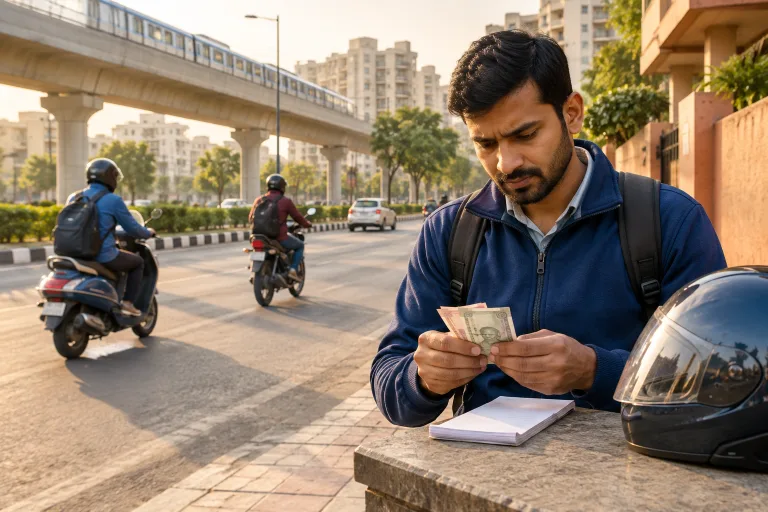
The line says you work for yourself, and the app only connects you with orders. In practice it means no salary, no PF, no legal minimum wage, no bonus and no paid leave, and that your costs and many risks are yours. In return you choose when to log in. Quick commerce terms put it plainly: the delivery partner is not the company's employee but an independent service provider (AajTak, 21 September 2026). This post reads that line from the rider's side. It is general information, not legal advice.
Where the words come from
Indian law now has its own names for this kind of work. The Code on Social Security, 2020 calls a gig worker someone who earns "outside of traditional employer-employee relationship", and calls platform work an arrangement "outside of a traditional employer-employee relationship" in which people use an online platform to provide services for payment (Code on Social Security, section 2, PRS copy). App terms say "independent contractor", "independent service provider" or "partner". The idea is the same: no employer, no employee.
What the line takes away
Most worker rights in India are written for employees. With the contractor label you are outside them:
| Right | Employee | Independent contractor |
|---|---|---|
| Minimum wage | Yes | No floor under per-order pay |
| Yearly bonus | If eligible | No |
| Paid annual leave | After 180 days' work in a year | No |
| PF and ESIC | Within the wage limits | No PF (AajTak) |
| Costs of the work | Employer's | Yours: fuel, phone, upkeep |
Details of each row are in our main post: are delivery partners employees?
The same AajTak report lists what the terms put on the rider: training and onboarding fees, tax included, that can be cut from your payouts, and a payout worked out from distance, time, traffic, weather and orders. Fairwork India, which rates apps on working conditions, puts the risk side plainly: under "independent contractor" classifications workers can carry "a disproportionate amount of risk", may be liable for damage arising during their work, and may be kept from seeking redress by unfair clauses (Fairwork India Ratings 2024, October 2024).
What it leaves you
- Your time is yours. You pick your login time (AajTak, linked above).
- You can work for more than one app. And under the 2026 rules your days on different apps add up for welfare schemes: working for two delivery apps at once.
- A separate track of social security. Registration on e-Shram and schemes for gig and platform workers: gig workers' social security and e-Shram.
- Whatever the app adds on its own. Fairwork's 2024 ratings gave bigbasket, Swiggy, Urban Company, Zepto and Zomato a point for accident insurance at no cost to the worker, for paying something when a worker can't work for medical reasons other than an accident, and for keeping a worker's standing safe after a notified break (Fairwork, linked above). That is company policy, not a legal right, and it can change.
The label is being questioned
- In the Supreme Court: a 2021 petition by the Indian Federation of App-based Transport Workers argues that calling riders "partners" instead of employees keeps social security away from them. The case, WP (C) 1068/2021, is listed as pending (Supreme Court Observer, as of October 2026).
- In Delhi: in May 2025 the Rajdhani App Workers' Union complained to the Delhi Labour Department against Zepto and one of its vendors, alleging, among other things, that workers were classified as independent contractors rather than employees and denied minimum wage, ESI and PF. Zepto called it a localised issue and said it had started an audit of the vendor (Storyboard18, 21 May 2025).
- In tax law: ride apps such as Rapido work on a subscription model in some states, where the captain keeps the fare (AajTak, 28 September 2026). Even so, when Rapido described a model in which independent drivers subscribe to its app, Karnataka's Authority for Advance Ruling held in July 2024 that Rapido counts as an e-commerce operator and must pay the GST on rides supplied through its platform (LiveLaw, July 2024). A label in a contract doesn't settle every legal question.
None of this changes your status today. Until a court or a new law says otherwise, the line in your terms stands.
What to check in your own terms
Fairwork's test for fair contracts is a good checklist (Fairwork, linked above). Look for:
- Who you are contracting with. The app, or a vendor? The name should be in the document.
- Language you can read. Terms in full, in words you understand, and available to you at any time in the app or on paper.
- Fees and deductions. Which fees, how much, and in how many instalments they come off your payouts.
- Liability. What you must pay for if goods, the bag or a vehicle are damaged.
- Changes. Whether you're told before the terms change.
- How it ends. Notice, the last payout, and returning the kit.
Take a screenshot of the terms on the day you accept them, because they can be updated later. What each company asks of riders in Delhi NCR: our Zepto guide and Rapido guide.
Want delivery work in Delhi NCR?
One form: name, phone, city and area.