On the job
Delivery bag, T-shirt, helmet and carrier: what riders pay for and what companies provide (2026)
The branded bag and T-shirt come from the company but are charged to you. The helmet, phone mount and any carrier are yours to buy, and the law in Delhi NCR decides which kind you can ride with. Item by item, with the rules and fines.
By Editorial team Published
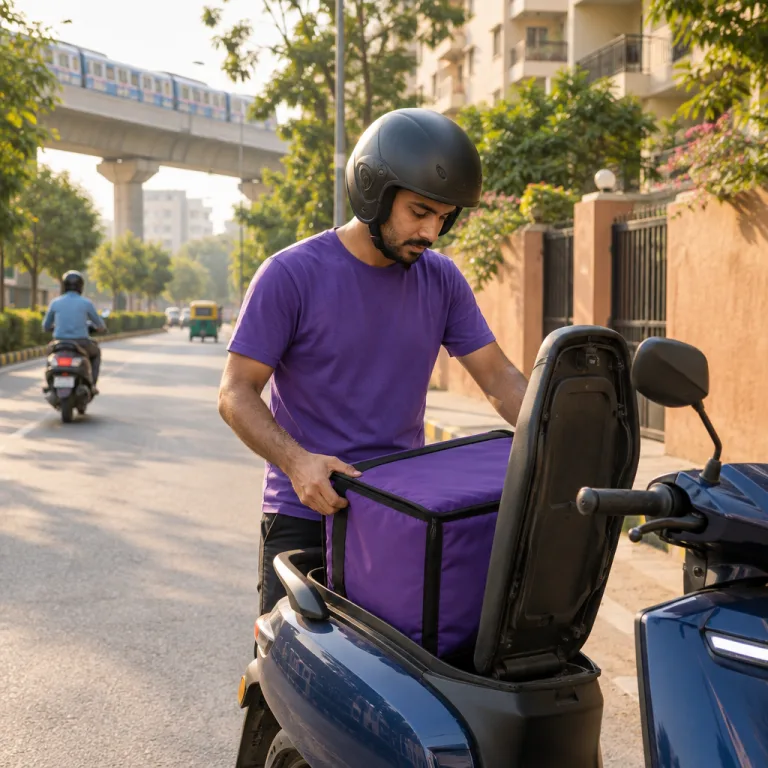
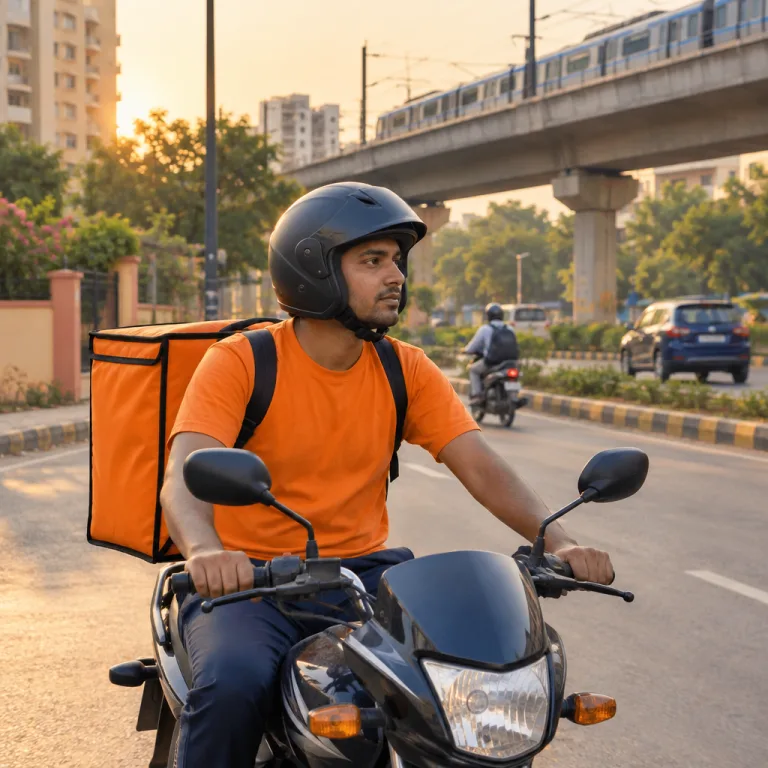
On apps like Swiggy and Zomato, the branded bag and T-shirt are handed over by the company when you join, but the rider pays for them, either inside the joining charges or through cuts from payouts. The rest of your kit is your own purchase: the helmet, a phone mount, a carrier or top box. For each of those, Delhi NCR's traffic law decides what is allowed, and the wrong choice can end in a challan. Everything below was checked on 30 October 2026.
The kit at a glance
| Item | Where it comes from | Who pays | What to watch |
|---|---|---|---|
| Branded bag and T-shirt | The delivery company, at onboarding | You | Kit cost can be recovered from payouts; damage or replacement can cost extra |
| Helmet | You buy it | You | Needs the ISI mark under the BIS standard |
| Phone mount | You buy it | You | Holding the phone while riding is a challan |
| Carrier or top box | You buy and fit it | You | No changes that put the bike at odds with its RC; no load sticking out |
| Food bag hygiene | Your daily routine | Your time | FSSAI wants delivery staff trained in hygiene |
The rules and figures behind each row are in the sections below, each with its source.
Bag and T-shirt: handed over by the company, charged to you
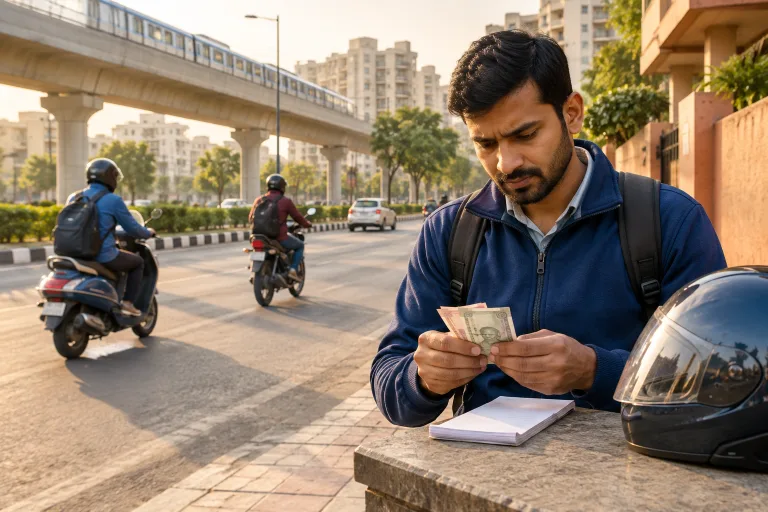
In January 2026, Indian Express reporter Soumyarendra Barik spent three days delivering for Zomato, Blinkit and Swiggy in Delhi. Counting the costs of getting started, he wrote that workers pay for the companies' jerseys and carrying bags, even though the kit ends up turning them into "hyperlocal advertising boards" for the apps. Signing up cost him ₹1,201 on Swiggy and ₹1,799 on Zomato, and both offered to take the money in instalments from his earnings (Indian Express, 14 January 2026). He did not say how much of either sum was for the kit.
A September 2026 report on fees at platforms such as Swiggy and Zepto describes the same pattern. The kit can include a delivery bag, a T-shirt, a jacket or other items; its cost can be added to the partner's account and recovered from earnings later; and a damaged item, or a fresh set of kit, can bring an extra charge. The report's advice: find out the kit cost before you start, not only the joining fee (Aaj Tak Bangla, 22 September 2026).
So the "price" of a branded delivery bag is not something you pay at a shop counter. It comes out of what joining costs you. Two posts look at this brand by brand:
- Swiggy: what the Delhi joiner found about the jersey and bag: paying for the jersey and bag.
- Zepto: what to do if the T-shirt or bag is lost or torn: lost or damaged Zepto kit. Zepto's own rider terms on fees and kit are summarised on our Zepto page.
What each company says about joining charges is in our joining fees guide. When you stop working, hand the kit back as the app asks: see leaving a delivery app the right way.
Helmet: your purchase, and it must carry the ISI mark
The helmet is the one piece of kit the law insists on, for you and for anyone riding behind you. Since 2021, a Quality Control Order has required two-wheeler helmets to carry BIS certification under IS 4151:2015, and the government warned in July 2025 that many helmets sold at the roadside lack that certification (Siasat / IANS, 5 July 2025).
A cheap uncertified helmet is also a challan risk. Delhi Traffic Police list "Defective Helmet (Not Confirming BIS)" as a ₹1,000 offence under section 194D, the same amount as riding without a helmet or with the strap undone (Delhi Traffic Police fine list, as of October 2026).
How to tell a genuine ISI helmet from a fake before you pay, and how to check the maker's licence: ISI-marked helmets and how to spot a fake. Who must wear one and the pillion rule: helmet rules across NCR.
Phone mount: keep the phone out of your hand
The delivery app runs your whole shift, so the phone has to sit somewhere you can see it. The national driving rules say a driver shall not use any hand-held mobile phone; since 1 October 2020 the one exception is use solely for route navigation, with the device fixed on the dashboard (the rule's words) so it doesn't break the driver's concentration (Motor Vehicles (Driving) Regulations, 2017, regulation 37; 2020 amendment, G.S.R. 586(E)).
In Delhi, using a hand-held device while driving is a ₹5,000 challan the first time and ₹10,000 after that (Delhi Traffic Police fine list, as of October 2026). What that means on a bike, and what to do when an order pops up mid-ride: phone on the handlebar. Choosing the phone itself: which phone for delivery work.
Carrier or top box: extra space, within the rules
A rack or box helps on parcel and grocery runs, but how you fit it matters. Section 52 of the Motor Vehicles Act says no owner shall alter a vehicle so that the particulars in its registration certificate differ from what the manufacturer specified (Motor Vehicles (Amendment) Act, 2000, section 2). An owner who alters a vehicle, retrofitted parts included, in a way the law doesn't permit faces a fine of ₹5,000 per alteration, up to six months in jail, or both (section 182A(4), added by the Motor Vehicles (Amendment) Act, 2019).
The load rules matter just as much. Nothing you carry may stick out beyond the sides, front or rear, and no load may hide the number plate (Driving Regulations 35 and 36, linked above). A load that sticks out carries a ₹20,000 fine under section 194(1A), which Delhi's list shows as "Carrying high/long load" (Delhi Traffic Police fine list, as of October 2026). Details: top boxes and carriers on a delivery bike, and for packing heavy orders, atta bags, water cans and riding with weight.
The food bag: cleaning it is part of the job
The bag is not only a cost; it is where the customer's food sits. In December 2024 the food regulator FSSAI told e-commerce food businesses to train their last-mile delivery staff in food safety and hygiene, and to deliver food and non-food items separately so one doesn't contaminate the other (FSSAI advisory, 3 December 2024). What that means for your daily bag routine: keeping the food bag clean.
Don't buy branded kit second-hand
If someone offers you a branded delivery T-shirt or bag second-hand, say no. The kit is meant to come from the company with your own account, and the "delivery look" has been used in NCR crimes: in May 2025, one of seven people arrested over a knifepoint robbery at a Punjabi Bagh hotel had scouted it in a delivery T-shirt, pretending to be a food delivery rider (Deccan Herald / PTI, 31 May 2025). More cases, and why second-hand kit can get you into trouble: buying a used branded bag or T-shirt online. Kit that comes bundled with someone else's login is worse still: renting or borrowing a delivery ID.
Five kit questions to ask before you join
- Is the bag and T-shirt included in the joining charge I'm shown, or charged separately?
- Is the cost taken at once, or cut from my payouts in instalments? Over how many weeks?
- What happens if the bag tears or the T-shirt is lost? Is there a replacement charge?
- Do I return the kit when I leave, and is any deposit refundable?
- Which helmet, mount or carrier do I need to arrange myself before my first shift?
Ask these in the company's own app or at its hub, and keep the answers as screenshots. Our joining fees guide also explains how to tell a real company fee from a recruiter's scam.
Ready to start?
Kit questions sorted? The next step is the work itself: Apply for a delivery job.