Rules and law
Delhi-Meerut Expressway and NH-9: which lanes bikes may use
Between Delhi and Dasna, NH-9 is two roads in one: six fast expressway lanes in the middle, where bikes are banned, and four lanes on each side, where bikes ride. How to tell them apart, where the police stand, and what a wrong ramp has cost.
By Editorial team Published
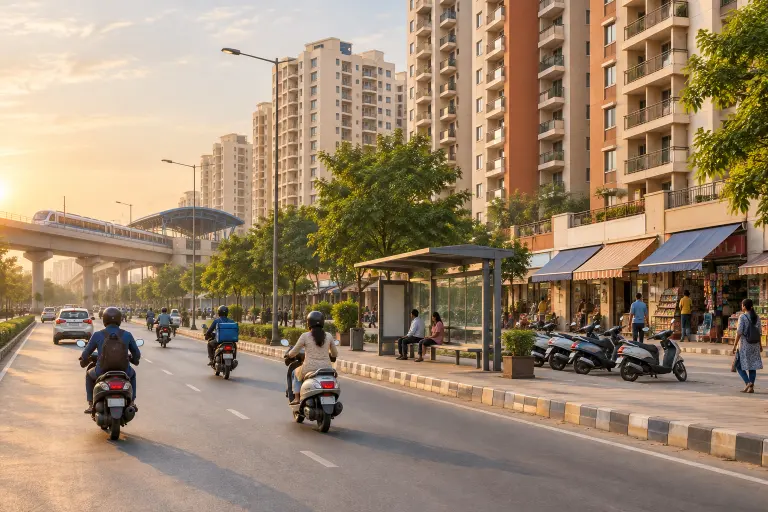
No, a bike is not allowed on the Delhi-Meerut Expressway itself. Yes, a bike can ride NH-9 between Delhi and Dasna, in the lanes on either side of the expressway. On that stretch the road was planned with 14 lanes: a 6-lane expressway in the middle and 4+4 service lanes beside it (EPC World, 28 May 2018). The middle six are closed to two-wheelers. The outer four on your side are yours. This is the rule as of October 2026.
How the road is laid out
The government's plan for the project, as reported when the first part opened in May 2018 (EPC World, 28 May 2018):
| Part | Length | Lanes |
|---|---|---|
| Whole project | 82 km | |
| Delhi to Dasna | first 27.74 km | 14: a 6-lane expressway plus 4+4 service lanes |
| Nizamuddin Bridge to the Delhi-UP border | 8.36 km | 14, with a 2.5-metre cycle track on each side |
| Dasna onwards | rest of the route | 6-lane expressway |
So the side lanes exist only up to Dasna. Past it there is no lane for a bike on this road, and a rider going further towards Meerut needs another route.
Expressway lane or side lane: how to tell
- The expressway lanes are the middle carriageway. You join them only by a ramp at an entry point.
- The side lanes run along the outer edge of the road, on both sides.
- If a slip road climbs up to join the fast lanes and has a no-entry board for two-wheelers, it is the wrong one.
Who checks, and where
Traffic staff are posted at the entry and exit points of the expressway to stop two-wheelers and tractors from getting on, officials said in August 2025, and a traffic police official added that riders still try to use the expressway lanes despite the ban (Swarajya, 30 August 2025). After a constable was killed there, Ghaziabad traffic police told staff not to stand on the expressway itself, and movable barriers were planned at every ramp. The same report says NHAI got approval for a ₹18 crore safety plan that includes fencing both sides of a 15 km stretch, number-plate readers in the underpasses and traffic booths at entry and exit points.
What getting it wrong has cost
- August 2022: Ghaziabad traffic police said banned vehicles on the expressway were fined ₹1,000 per violation, and that the fine would go up to ₹20,000 once NHAI finished the paperwork. NHAI's project director said automatic number-plate cameras were already in place at the entry and exit points (India.com, 1 August 2022).
- November 2024: a petition in the Delhi High Court challenged a ₹20,000 penalty on motorcyclists along with NHAI's 2018 ban on two-wheelers on access-controlled expressways. The court did not take it up and left the ban in place (Bar & Bench, 13 November 2024).
The fine charged today is not on record. A camera challan goes to the bike's number, so if you ever took a wrong ramp, check: e-challans in Delhi, UP and Haryana.
For riders in Indirapuram, Vaishali and East Delhi
The side lanes are part of daily work if you deliver around Indirapuram or Vaishali and cross into East Delhi. A few habits help:
- Take the service lane from the start of your trip. Changing your mind at a ramp is where riders get caught.
- Keep left in the side lanes and leave room for vehicles that pull over without warning.
- Inside Delhi, a bike's limit on NH-9 is lower than a car's. From Millennium Park to the Ghazipur border, Delhi Traffic Police list 60 km/h for two-wheelers and 70 km/h for cars, as of October 2026 (Delhi Traffic Police, maximum speed limits). Stretch-by-stretch limits are in speed limits for bikes on Delhi roads.
Other NCR roads where bikes are banned, and the ones where they're allowed: where bikes can and can't go in NCR.