News
Delhi EV Policy 2026 for delivery riders: subsidies, road tax and what changes for your bike
What the Delhi Electric Vehicles Policy 2026 means if you ride for deliveries: the purchase subsidy, road tax and registration waiver, the scrapping incentive, the fleet rules for delivery companies and the goods-permit exemption.
By Editorial team Published
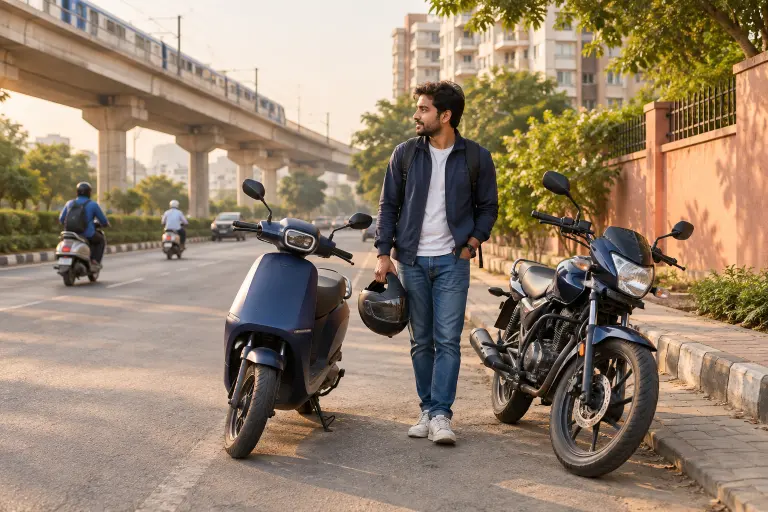
Delhi's new EV policy is mostly about money and dates. If you buy an electric scooter and register it in Delhi, you can claim a subsidy, you pay no road tax and no registration fee, and you get extra money if you scrap an old bike. Delivery companies also face rules on which two-wheelers they may add to their fleets. This post explains each part in plain words, straight from the government notification, and links to a shorter post on each topic.
The policy in one minute
The Delhi Electric Vehicles Policy 2026 was notified by the Delhi Transport Department on 30 June 2026 and applies from 1 July 2026 until 31 March 2030, unless the government extends or changes it (Delhi Gazette notification, checked 22 October 2026).
The policy says why two-wheelers are at the centre of it: two-wheelers are about 67% of all vehicles in Delhi, so moving them to electric matters for clean air (same notification, clause 1.3).
| What | What the policy says | Who it is for |
|---|---|---|
| Purchase subsidy | Up to ₹30,000 for an e-two-wheeler registered in the first year, less in later years | Delhi residents who buy and register the EV in Delhi |
| Road tax and registration fee | 100% waived | EVs bought and registered in Delhi during the policy period |
| Scrapping incentive | ₹10,000 when you scrap a Delhi-registered BS-IV or older two-wheeler and buy an EV | The owner of the scrapped vehicle |
| Fleet rule | No new petrol or diesel two-wheelers in delivery fleets; BS-VI allowed only up to 31 December 2026 | Delivery companies and fleet aggregators |
| New registrations | From 1 April 2028, only electric two-wheelers can be newly registered in Delhi | Everyone buying a new two-wheeler in Delhi |
All figures are from the Delhi Gazette notification of 30 June 2026, checked 22 October 2026. Each row is explained below.
The subsidy if you buy your own e-scooter
The purchase subsidy is paid straight into the buyer's bank account (direct benefit transfer). It depends on the battery size and on the year the scooter is registered, counted from the date of the notification:
| Year of registration | Subsidy |
|---|---|
| Year 1 | ₹10,000 per kWh, up to ₹30,000 |
| Year 2 | ₹6,600 per kWh, up to ₹20,000 |
| Year 3 | ₹3,300 per kWh, up to ₹10,000 |
The conditions matter more than the amount:
- The scooter's ex-showroom price must not be above ₹2.25 lakh.
- Only models approved by the Transport Department's Model Approval Committee qualify.
- Both plug-in and battery-swapping models count.
- You must be a resident of Delhi and the scooter must be bought and registered in Delhi.
- You apply within 30 days of your RC being generated; the money is due within 60 days of the application.
(Clauses 4.1 and 4.2 of the policy, checked 22 October 2026.)
Many riders have already applied. The Pioneer reported on 25 September 2026 that the Delhi government had received 5,678 applications since July, 5,621 of them for electric two-wheelers, and that 4,014 were still being processed at that time (The Pioneer, as of September 2026). So plan for a wait before the money arrives.
Who can claim, which papers you need and how the online portal works: our post on the Delhi e-scooter subsidy.
No road tax, no registration fee
Electric vehicles bought and registered in Delhi during the policy period get a 100% exemption from road tax for the life of the vehicle, and from the registration fee when the vehicle is registered (clause 4.7.1 of the policy, checked 22 October 2026). Expensive electric cars have their own limits, but for a two-wheeler the waiver is simple.
What the waiver does not cover, and which papers an EV still needs for delivery work: road tax and registration on an EV in Delhi.
Money for scrapping your old petrol bike
If you scrap a Delhi-registered BS-IV or older two-wheeler at an authorised scrapping facility, you get a Certificate of Deposit. Buy a new electric two-wheeler under the policy within six months of that certificate and you get a scrapping incentive of ₹10,000. Only the owner of the scrapped vehicle can claim it (clauses 4.6.1 and 4.6.7 of the policy, checked 22 October 2026).
How scrapping works step by step, and what to carry to the scrapping centre: scrapping your old petrol bike in Delhi.
What changes for delivery companies, and for you
This part affects riders who work on a company or fleet vehicle. The policy says no petrol or diesel two-wheelers may be added to the existing fleets of fleet aggregators and delivery service providers from 1 January 2026, but BS-VI two-wheelers may still be added up to 31 December 2026 (clause 8.5.1 of the policy, checked 22 October 2026).
In plain words: from 2027, a delivery company or fleet operator in Delhi can add only electric two-wheelers to its fleet. The rule is about company fleets. It does not say that a rider must sell a petrol bike they already own.
A second date is further away. From 1 April 2028, only electric two-wheelers can be newly registered in Delhi (clause 8.2.1). A petrol bike bought and registered before then is not affected by this clause.
What this can mean for you:
- More delivery work in Delhi may come with an electric vehicle offered on rent. Our EV rental guide lists which companies help with an EV and what to ask about the rent.
- If you plan to buy, an electric scooter registered in Delhi gets the subsidy and the tax waiver above. A petrol bike gets neither.
Do electric delivery scooters need a goods permit?
A separate central government notification of 6 July 2026 says that for seven years, battery-operated transport vehicles carrying goods or passengers do not need a permit, as long as they are fitted with a vehicle location tracking device that meets the AIS-140 standard (Gazette of India, S.O. 3679(E), checked 22 October 2026).
Who this applies to, and what to ask a rental company: our post on goods permits for electric delivery two-wheelers.
Low-speed e-scooters are a different case
Very slow battery scooters are not counted as motor vehicles at all, so the rules above don't work the same way for them. Under the Central Motor Vehicles Rules, a two-wheel battery vehicle is not a motor vehicle only if an approved testing agency has verified a top speed under 25 km/h, a motor under 0.25 kW and an unladen weight (without battery) of not more than 60 kg (Central Motor Vehicles Rules, rule 2(u), checked 22 October 2026). The policy's subsidy is claimed after an RC is generated, and such low-speed models are not registered.
A change to these limits was proposed in August 2026, and some dealers sell faster scooters as "low-speed". Details in low-speed e-scooters: the licence-free rule and the proposed change. If you have no bike at all, see our guide to delivery jobs without a bike.
Charging and battery swapping
The policy makes Delhi Transco Limited the nodal agency for public charging and battery-swapping stations, and asks housing societies and residential communities to help set up community charging points (clauses 5.2 and 5.10 of the policy, checked 22 October 2026). It also says the power companies, through the regulator DERC, may explore time-of-day tariffs to lower EV charging costs (clause 5.11). That is a "may explore", not a new rate.
For riders the practical questions are where to swap and how to charge safely at home:
If you live in Noida, Gurugram or Ghaziabad
The Delhi policy pays only Delhi residents who buy and register the vehicle in Delhi (clause 4.1.1). If you live and register your scooter in Uttar Pradesh or Haryana, the Delhi subsidy and tax waiver don't apply to you, even if you deliver in Delhi every day. Also note that a vehicle that gets the Delhi subsidy can't get a No Objection Certificate to move to another state's registration for three years from the policy's notification (clause 4.1.4).
Buy, rent or wait?
There is no single right answer. Some honest points:
- Buying needs money up front. The subsidy comes later, after the RC and an online claim, and many claims were still pending in September 2026 (see the numbers above).
- Renting an EV costs you a weekly or daily rent, but no down payment for the vehicle itself. Ask for the full cost in writing before you sign. Our EV rental guide has the questions to ask.
- Keeping your petrol bike is allowed. The fleet rule and the 2028 registration rule don't take away a bike you already own.
Ready to start?
Whether you ride petrol, electric or don't have a bike yet, you can fill in one short form.