News
Low-speed e-scooters: the licence-free rule, the 'fake low-speed' alert and the proposed change
Which battery scooters can be ridden without a licence, why the transport ministry warned about dealers selling faster scooters as low-speed, and what the August 2026 draft rule would change. Status as of October 2026.
By Editorial team Published
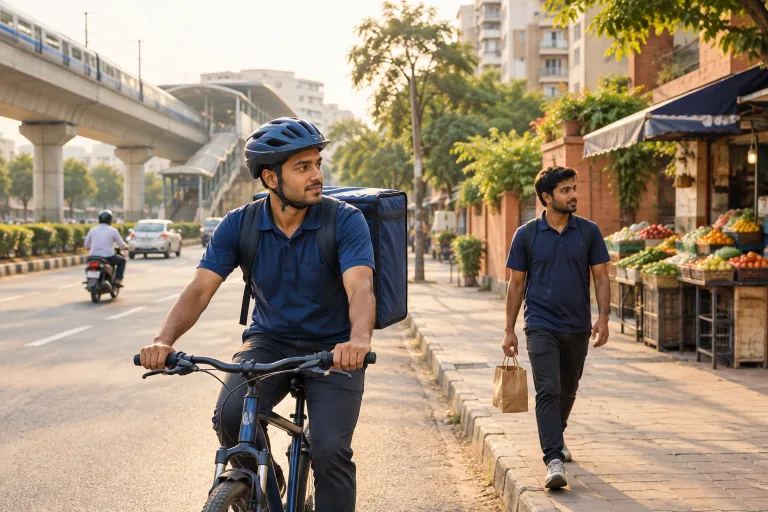
You can ride a battery scooter without a driving licence or registration only if it is a verified low-speed model: top speed under 25 km/h, a very small motor and a light frame, all checked by an approved testing agency. Some scooters sold as "low-speed" are faster, and then they are ordinary motor vehicles. In August 2026 the transport ministry proposed raising the motor limit and dropping the weight limit. When we checked on 22 October 2026 that change had been published only as a draft, so the current rule below still applies.
The rule today
The Central Motor Vehicles Rules say a two-wheel battery vehicle is not a motor vehicle if a testing agency named in rule 126 has verified all of these (Central Motor Vehicles Rules, rule 2(u), checked 22 October 2026):
| Condition | Limit |
|---|---|
| Motor power (thirty-minute rating) | less than 0.25 kW |
| Top speed | less than 25 km/h |
| Weight without the battery | not more than 60 kg |
| Safety | suitable brakes, a white reflector in front and a red one at the back |
| Pedal-assist models | motor power cut down and off as the vehicle reaches 25 km/h |
If a scooter meets all of these and has the testing approval, it doesn't need registration and the licence rules for motor vehicles don't apply. If it misses even one, it is a motor vehicle: you need a driving licence, and the scooter needs registration and insurance.
The 'fake low-speed' alert
In October 2022 the Ministry of Road Transport and Highways warned state governments that vehicles with bigger batteries and speeds of 40–50 km/h were being sold as low-speed two-wheelers. It said dealers sold them without any type approval, ignored vehicle identification and insurance rules, and in some cases tampered with the testing agency's verification; it asked states to act against such dealers (Autocar Professional, 15 October 2022).
The problem has not gone away. In September 2026 Yulu's co-founder RK Misra told Autocar Professional that some imported bikes have a 25 km/h limit but also a switch that lets them go up to 40 or 45 (Autocar Professional, 12 September 2026).
For a delivery rider this is a real risk. If your "no-licence" scooter is in fact faster, you are riding a motor vehicle without a licence, registration or insurance.
The proposed change (August 2026)
On 21 August 2026 the ministry published draft amendment rules, G.S.R. 760(E), for public comments (TeamLease RegTech summary of the draft, checked 22 October 2026). The draft would:
- allow a motor with thirty-minute power below 0.6 kW (today: less than 0.25 kW);
- keep the top speed below 25 km/h;
- make pedal-assist motors cut off at 25 km/h, or earlier if pedalling stops;
- tie the safety checks to the AIS-049 and AIS-041 standards.
Autocar Professional reported that the draft also removes the 60 kg weight limit (Autocar Professional, 12 September 2026). Objections could be sent within 30 days of the draft being made public, and the draft proposed that the changes come into force from 1 October 2026, unless otherwise provided (TeamLease RegTech summary, above).
Who is against it
Yulu, which rents small electric bikes, has filed objections. It says removing the weight limit could let heavy, unregistered two-wheelers onto the roads and harm road safety, and it wants the 60 kg limit back, perhaps with a small margin for modern batteries (Autocar Professional, 12 September 2026, above).
Where it stands now
When we checked on 22 October 2026, the latest text we could find was the draft of 21 August 2026. A draft is not the law. Until a final notification is published in the Gazette, the limits in the first table apply. Before you buy or rent a scooter because it is "licence-free", check against the current rule, not the draft.
Before you buy or rent a "no-licence" scooter
- Ask for the testing approval paper from the seller or rental company.
- Check the top speed stated on that paper: it must be under 25 km/h.
- Don't accept a speed switch. A scooter that can be switched to go faster is not low-speed.
- No approval paper? Treat it as a motor vehicle: you need a licence, and it needs registration and insurance.
- No subsidy. The Delhi EV Policy 2026 subsidy is claimed after a registration certificate is made, and low-speed models are not registered. See our Delhi EV Policy 2026 explainer.
If you have no bike, our guide to delivery jobs without a bike shows which companies take riders on a cycle or e-cycle, and the EV rental guide covers renting an electric scooter instead.