News
Road tax and registration on an EV in Delhi (2026): what you don't pay
Under the Delhi EV Policy 2026 an electric scooter bought and registered in Delhi pays no road tax and no registration fee. What the waiver covers, what it doesn't, and which papers your EV still needs for delivery work.
By Editorial team Published
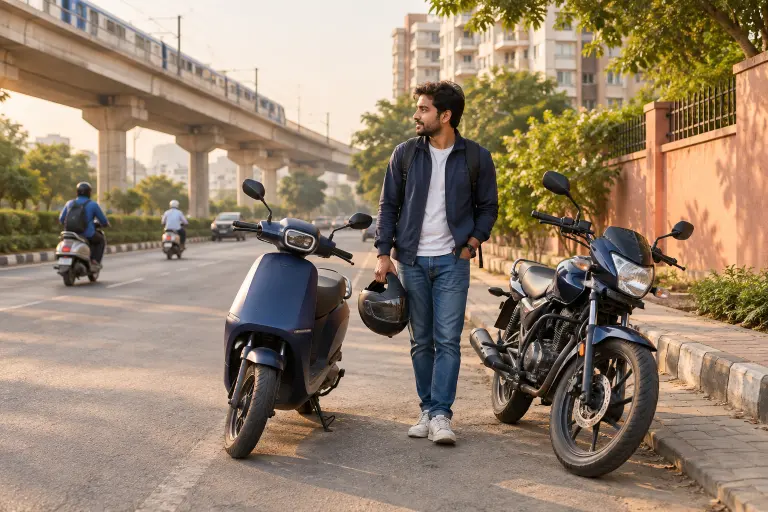
An electric scooter or bike that you buy and register in Delhi while the Delhi EV Policy 2026 is in force pays no road tax for its whole life and no registration fee when it is registered. That is the full rule for two-wheelers. It does not cover insurance, and it doesn't mean the scooter needs no papers. Details below, from the policy notification checked on 22 October 2026.
What the policy says
Clause 4.7.1 of the Delhi Electric Vehicles Policy 2026 says all electric vehicles purchased and registered in Delhi during the policy period get a 100% exemption from road tax for the life of the vehicle, and from registration fees at the time of registration (Delhi Gazette, checked 22 October 2026).
The policy period runs from 1 July 2026 to 31 March 2030 (clause 13.1 and the notification's opening lines, same source). Electric cars have separate limits based on their price (clauses 4.7.2 and 4.7.3); for electric two-wheelers there is no price limit on this waiver.
Who gets it
Three things must be true:
- The EV is bought during the policy period.
- It is registered in Delhi (the National Capital Territory).
- It is fully electric. The policy defines an electric vehicle as one powered only by an electric motor running on a battery in the vehicle (clause 3.1).
Unlike the purchase subsidy, the waiver text does not set a price cap for two-wheelers or ask you to apply separately. The Pioneer's report on the subsidy portal launch also described the road tax and registration fee exemption as applying to all eligible EVs (The Pioneer, 4 July 2026). Check the final on-road price breakup at the dealer to see that these two lines are zero.
If you register the scooter in Noida, Ghaziabad, Gurugram or Faridabad, this Delhi waiver does not apply; those states have their own rules.
What you still pay for
The waiver is about two government charges only. You still pay for:
- The scooter itself. The purchase subsidy, if you qualify, comes later into your bank account. See the Delhi e-scooter subsidy.
- Insurance. Road tax and the registration fee are waived, not insurance. What each delivery company asks for is in our documents guide.
- Dealer charges such as accessories or extended warranty. These are not government charges. Ask for each line in writing and say no to what you don't need.
Papers your EV still needs for delivery work
No road tax doesn't mean no papers. For an ordinary e-scooter (not a low-speed model), keep these ready:
- Driving licence. A normal e-scooter is a motor vehicle. Only a low-speed battery two-wheeler verified by an approved testing agency (top speed under 25 km/h, motor under 0.25 kW, unladen weight without battery not more than 60 kg) is not (Central Motor Vehicles Rules, rule 2(u), checked 22 October 2026).
- RC (registration certificate). You get one even though the fee is waived. You also need it to claim the subsidy: the 30-day claim window starts when the RC is generated (policy clause 4.1.3).
- Insurance papers.
- Whatever the delivery company lists. Each company has its own list; our documents guide shows what the main companies in Delhi NCR ask for.
Not sure about a paper the company asks for an EV? Ask the company or the rental firm before your first shift.
If you rent instead of buying
On a rented EV, the road tax and registration are the owner's business, which is the rental company. What matters for you is that the vehicle's RC and insurance are valid and that you have a driving licence if the scooter is not a low-speed model. Our EV rental guide lists what to check before you take a rented scooter.
More on the policy
The waiver is one part of the policy. The subsidy, the scrapping incentive and the new rules for delivery fleets are in our Delhi EV Policy 2026 explainer for riders.