Safety
Renting out your bank account for 'commission': the mule-account crime explained
'Just let money pass through your account, keep a cut.' That offer turns you into a money mule. What a mule account is, how Delhi gangs found account holders in 2026, including two ride-app drivers, what police charged, and what it costs you even if you never meet the fraudster.
By Editorial team Published
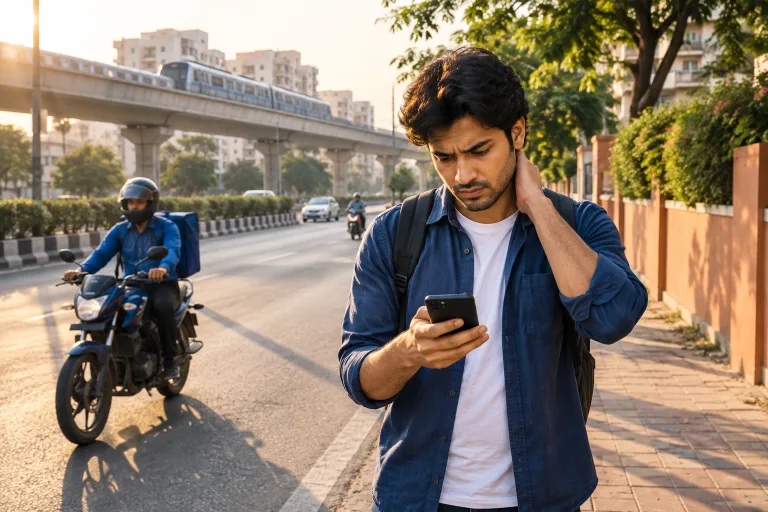
Don't let anyone use your bank account, UPI ID, QR code, ATM card or SIM for money, however small the job sounds. Someone who receives or passes on money for another person, where that money comes from fraud, is called a money mule. RBI warned in June 2026 that people who let others use their accounts can face penalties and even jail, and that you can be investigated even if you didn't know where the money came from (Free Press Journal, 13 June 2026).
Here is how it works in Delhi, and why riders get these offers.
What the offer sounds like
- "Your account is only for receiving payments for my business. You keep a share."
- "Open a new account, give me the card and SIM, I'll pay you."
- "Lend me your QR code for a few days."
- "A job: just transfer what comes in, keep a commission."
Every one of these is the same thing. Fraud victims' money lands in your account, moves on, and your name is the one on the complaint.
Delhi cases from 2026
- Two ride-app drivers from Kapashera (April 2026). In a fake-loan-app case, Delhi Police arrested two men described as Rapido drivers. One told police he had shared his bank account details with the other for a commission; his account was linked to several complaints (Millennium Post, 11 April 2026). In the same case, a 23-year-old was said to have rented out his UPI-linked QR code to the gang for money (ThePrint/PTI, 9 April 2026).
- East Delhi gang that hunted for job-seekers (June 2026). East district cyber police arrested ten people who ran a mule-account supply network. They targeted unemployed and financially weak people with false promises of jobs and money, and took over their ATM cards, cheque books, registered mobile numbers and internet banking logins. The FIR was under sections 112(2) and 318(4) of the Bharatiya Nyaya Sanhita (IANS, 16 June 2026).
- Paharganj (June 2026). In a syndicate supplying accounts and payment machines, account holders were allegedly paid around eight per cent commission, with middlemen earning two to four per cent more (ETV Bharat, 22 June 2026).
- North-East Delhi (July 2026). A man opened a bank account for ₹50,000 on someone's instructions; it was sold on for ₹1 lakh and ended up with fraudsters, who used it for a courier scam. He was among four arrested (IANS, 14 July 2026).
The small payment is the bait. The account police trace is in your name.
Why these gangs look for riders
Delhi Police said in January 2026 that mule bank accounts continue to be a major challenge; the same report says they are typically opened by people from economically weaker sections in exchange for a commission (ThePrint/PTI, 12 January 2026). The East Delhi gang above went after people looking for work. A rider between jobs, or one waiting for a payout, is exactly who they want.
What it costs you
- Arrest and a criminal case, as in every case above.
- A frozen account, with your own payouts stuck inside. How freezes work: bank account frozen after a cyber complaint.
- Your name on the complaint, not the fraudster's.
It is the same logic as lending out your delivery ID: whatever happens on it is on your record. See renting out or borrowing a delivery ID.
How to say no, and what to do if you already said yes
- Say no to every offer that pays you for "using" your account, card, SIM or QR code.
- Never open an account for someone else. RBI's advice: don't open accounts for others, don't let unknown people use yours, and keep card details, PINs and OTPs to yourself (Free Press Journal, 13 June 2026, as above).
- Already handed over a card or login? Go to your bank, block the card, change your internet banking password and UPI PIN, and tell the bank in writing what happened. If money you don't recognise has moved through your account, report it on 1930 or cybercrime.gov.in: the reporting steps.
- Police advice: East Delhi cyber police urged people not to share, sell or let others use their bank accounts, ATM cards or cheque books, as this helps cyber fraud and may bring serious legal consequences (IANS, 16 June 2026, as above).
More money traps around your earnings: UPI frauds, loan apps and fake refunds in Delhi NCR. Want delivery work where the pay comes from the work? Apply for a delivery job.