Safety
Night shifts in Delhi's cold wave: what to wear and when to stop
On a bike, a Delhi winter night feels colder than the thermometer says. What IMD counts as a cold wave, the layers and cover it advises, the warning signs of hypothermia and frostbite, and the heater risk back in your room.
By Editorial team Published
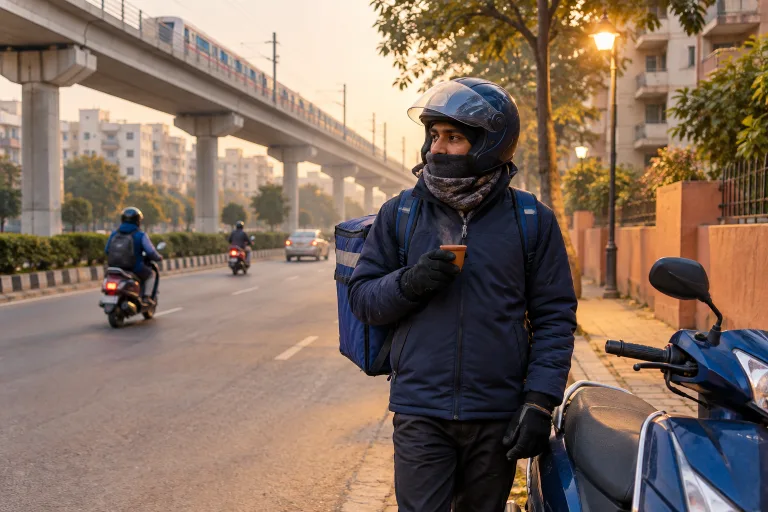
For a night shift in a Delhi cold wave, wear several thin warm layers with a windproof layer on top, cover your head, neck, hands and feet, and stay dry. Stop riding and get indoors if you can't stop shivering, if your fingers or toes go numb and pale, or if you feel confused or drowsy. That is what the India Meteorological Department (IMD) advises for cold waves, put into a rider's terms below (as of November 2026).
Last winter, IMD recorded cold wave conditions in Delhi on 11, 12, 13, 14, 15 and 26 January 2026. The lowest temperature of that month was 2.3°C, at Palam on 15 January (IMD, Monthly Weather Report of Delhi, January 2026).
What counts as a cold wave
IMD's rules for the plains, from its cold wave FAQ (IMD, FAQ on Cold Wave, read 9 November 2026):
| IMD term | When it is declared (plains) |
|---|---|
| Cold wave | Minimum temperature 10°C or less and 4.5°C to 6.4°C below normal, or the minimum itself is 4°C or less |
| Severe cold wave | Minimum temperature 10°C or less and 6.4°C or more below normal, or the minimum itself is 2°C or less |
| Cold day | Minimum 10°C or less, and the day's maximum is 4.5°C to 6.4°C below normal |
IMD also says wind makes a cold wave worse (the "wind chill" effect). On a bike you make your own wind, so a cold night feels colder while you ride than while you wait at a store.
Where to check: IMD's district-wise warnings show colour-coded cold wave warnings for the next five days.
What to wear on a night shift
IMD's advice for a cold wave, and what it means on a bike (same FAQ):
| IMD says | On the bike |
|---|---|
| Wear several loose, lightweight, warm woollen layers that keep the wind out, rather than one heavy layer; tight clothing reduces blood circulation | A thermal, a sweater and a windproof jacket on top beat one thick coat. Close the jacket at the neck and wrists. |
| Cover your head, neck, hands and toes; most heat is lost from these parts | A thin cap or balaclava that still lets your helmet fit and buckle properly; a muffler tucked inside the jacket so it can't flap. |
| Mittens are warmer than gloves | Mittens make brakes and clutch hard to use. Ride in warm full-finger gloves; keep mittens for waiting. |
| Wear insulated or waterproof shoes; keep socks and gloves dry | Closed shoes, not chappals. Carry a spare pair of socks. |
| Keep dry; if wet, change quickly | Sweat and drizzle both chill you. Change a damp layer at your break. |
Helmet rules still apply in winter: a cap goes under the helmet, never instead of it. See helmet rules across NCR.
Food, drinks and no alcohol
- Hot drinks, regularly. IMD advises drinking hot fluids often and eating healthy food, including fruit and vegetables rich in vitamin C (same FAQ).
- Don't wait to feel thirsty. IMD lists dehydration as a cold-weather risk, with signs such as dark urine, headache and dizziness (IMD, FAQ on Cold Wave, as of November 2026).
- No alcohol. IMD's cold wave advice says: "Don't drink alcohol. It reduces your body temperature." (same FAQ). And riding after a drink is an offence: see drink-driving checks in Delhi NCR.
When to stop: the warning signs
| Sign | What it can mean | What to do |
|---|---|---|
| Shivering that won't stop | Your body is losing heat. IMD: "Do not ignore shivering" | End the run, get indoors, warm up |
| Numb, white or pale fingers, toes, ear lobes or tip of the nose | Frostbite | Warm the area in warm, not hot, water. Don't rub or massage it |
| Confusion, slurred speech, drowsiness, stiff muscles | Hypothermia: body temperature falling too low | A medical emergency. Call 112 |
Source: IMD's FAQ, which lists shivering, "dizzy, drowsy", confusion, slurred speech, sleepiness and stiff muscles among the signs, and defines hypothermia as "a lowered core body temperature usually below 34.4 degree C. (94 degree F.)" (IMD, FAQ on Cold Wave, as of November 2026).
Numb hands also mean slow braking, and drowsiness on a bike is dangerous on its own. Stop before you reach that point, not after.
If a fellow rider has hypothermia, IMD's first aid is: get them into a warm place and take off wet clothes. Warm them with dry blankets or skin-to-skin contact, and give warm drinks. No alcohol, and nothing by mouth if they are unconscious. Then get medical help. Save the numbers in 112, 102 and CATS.
Back in your room: heaters and carbon monoxide
IMD's FAQ warns about carbon monoxide, a gas with no smell or colour that comes from engines, stoves and heaters burning fuel. Signs are headache, dizziness, weakness, nausea and drowsiness. Its advice: keep the room ventilated, turn heaters off when you don't need them, and never sleep in a vehicle with the engine running. If you charge an e-scooter in the same room, read charging an e-scooter in a rented room for fire safety too.
Plan the shift around the cold
- Shorter runs, warm breaks. Plan a break indoors every so often instead of riding straight through.
- Fog comes with the cold. On 15 January 2026 Delhi had a cold wave and dense fog on the same day (IMD January report, linked above). See riding in Delhi fog.
- Bonuses are not worth hypothermia. Late-night incentives can keep you out longer: last New Year's Eve, Zomato said it would pay ₹120–150 per order between 6 pm and midnight (The Week, 31 December 2025). Weigh any incentive against how cold you are. How pay and incentives work is in our pay and incentives guide.
- Late-shift safety: night delivery jobs in Delhi NCR. For the hot months, our summer heat safety guide is the same idea for the other end of the year.
Looking for delivery work this winter?
Our form takes your name, phone, city and area.