Safety
Dengue and bad-air season in Delhi NCR: health checks for delivery riders (Oct-Nov 2026)
Delhi's dengue count rose to 799 by 10 October 2026 and the air turned 'poor' the same month. What riders should watch for, where tests are free, when platelets are really needed, and how to read the AQI near your hub.
By Editorial team Published
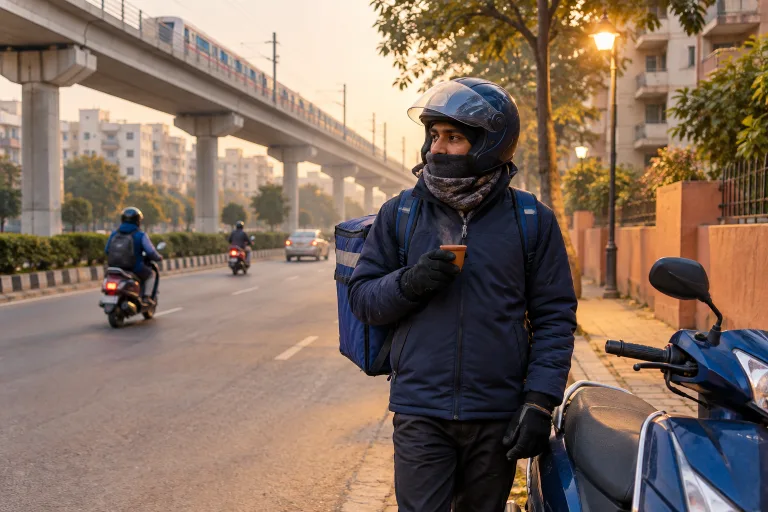
October and November are when two health risks overlap in Delhi NCR: dengue after the monsoon, and bad air as winter starts. A delivery rider meets both, because you are on the road through the day. This guide gives the current numbers, the signs that mean "stop riding today", where a dengue test costs nothing, what to know about platelets, and how to read the air quality near your hub. Each fact below carries a link to its source; we checked them all on 23 October 2026.
The short version
| If this happens | Do this | Read more |
|---|---|---|
| Sudden high fever, pain behind the eyes, body ache | Stop taking orders and get a blood test | Warning signs |
| Fever for more than 3 days | Ask for a complete blood count (CBC) | Free tests |
| Belly pain, repeated vomiting, bleeding gums, dizziness | Go to a hospital now | Warning signs |
| Not sure if it is dengue, malaria or chikungunya | Only a test can tell | The three compared |
| A doctor asks the family to arrange platelets | Check stock before you travel | Platelets and blood banks |
| AQI near your hub is 'poor' or worse | Plan breaks away from heavy traffic | AQI hotspots |
Where Delhi's dengue count stands
The Municipal Corporation of Delhi (MCD) puts out a weekly report on mosquito-borne diseases. Its report for the week ending 10 October 2026 counted 799 dengue cases this year, with 202 of them in the first ten days of October (PTI, 13 October 2026). September had 286 cases, the highest month of the year so far, after 90 in August (PTI, 6 October 2026). No one had died of dengue or malaria in Delhi this year at that point, the same October reports say.
So the numbers were still going up in October. The year is lower than the three before it, though: by 12 September 2026 the count was 432, against 619 at the same point in 2025 and 709 in 2024 (PTI, 15 September 2026). The full week-by-week picture, and which MCD zones report the most cases, is in Dengue cases in Delhi in 2026.
Why riders are exposed
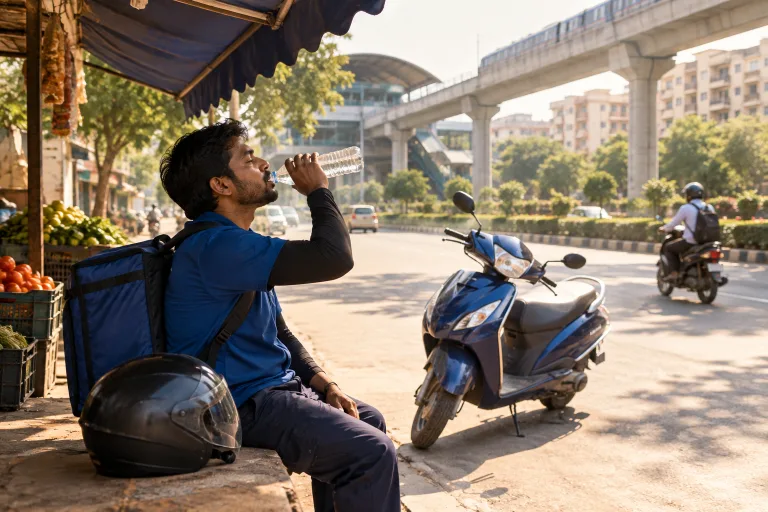
The mosquitoes that spread dengue are active during the day (WHO dengue fact sheet, as of October 2026). That is exactly when you are waiting outside restaurants, dark stores and parcel hubs.
The National Centre for Vector Borne Diseases Control (NCVBDC) gives simple steps (NCVBDC do's and don'ts, as of October 2026):
- Don't wear clothes that leave arms and legs bare. Full sleeves under your jacket help.
- Use mosquito nets or repellent if you sleep during the day, for example after a night shift.
- Empty coolers and small containers at least once a week. Water standing in drains, garbage and coolers for more than a week is a warning sign for dengue.
That last point matters in shared rooms. In 2026, up to 10 October, MCD checks turned up mosquitoes breeding in about 1.98 lakh homes (PTI, 13 October 2026). Check the cooler, the water drum and the flower pots where you live.
Fever on a working day: what to watch
Dengue usually starts with a sudden high fever, a strong headache at the front of the head, pain behind the eyes that gets worse when you move them, muscle and joint pain, loss of appetite, a rash on the chest and arms, and nausea or vomiting (NCVBDC, signs and symptoms, as of October 2026).
The tricky part: the dangerous phase often starts when the fever comes down. In the national dengue guidelines, this critical phase tends to set in from around day 3 or 4 of the fever and runs for a day or two (24 to 48 hours) (National Guidelines for Clinical Management of Dengue Fever 2023). WHO makes the same point in its fact sheet: severe dengue tends to show up once the fever has gone. So a day without fever is not the day to go back on the bike.
What the guidelines tell patients at home:
- Rest in bed and drink enough fluids such as ORS or coconut water; avoid fizzy drinks.
- For fever, take paracetamol. Avoid aspirin and NSAIDs (painkillers like ibuprofen); WHO says they can raise the risk of bleeding.
- Get a CBC (with platelet count) if the fever has lasted more than 3 days.
- Go back to the doctor at once with any warning sign: severe belly pain, vomiting again and again, red spots on the skin, bleeding from nose or gums, vomiting blood, black stools, drowsiness, cold and clammy skin, or difficulty breathing.
Dizziness and fainting are on the guidelines' warning list too. On a bike in traffic, that alone is a reason to stop. The full list, and what to do on each day of the fever, is in Dengue warning signs: when to stop riding. Keep the Delhi NCR emergency numbers saved in your phone.
Dengue, malaria or chikungunya?
Dengue is not the only fever going round. The MCD's count up to 10 October 2026 also had 294 malaria and 32 chikungunya cases (PTI, 13 October 2026). They start in similar ways, and the guidelines note that dengue can come together with malaria or chikungunya. A blood test is the only way to know. Clues and tests for each are in Dengue, malaria or chikungunya?.
Where to get tested for free
The national programme runs a network of sentinel surveillance hospitals for dengue, and testing there is paid for by NCVBDC, not by you (2023 guidelines). Delhi has 35 of these hospitals on the 2025 list, from Narela and Jahangirpuri to Safdarjung and Khichripur (NCVBDC list, 2025), and the Delhi government activated the network for this season in June (Medical Dialogues, 27 June 2026). The same list names district hospitals in Gurugram, Faridabad, Ghaziabad and Noida.
Which test you get depends on the day: the NS1 test for samples taken on days 1 to 5 of fever, the IgM test after day 5 (2023 guidelines). The full list by area, and what Ayushman Arogya Mandirs offer, is in Free dengue tests in Delhi.
Platelets: what families should know
A falling platelet count frightens families, and many start calling blood banks. The 2023 guidelines don't back a transfusion for a low count alone: bleeding is what triggers it. Without bleeding, platelets may be considered only below 10,000 per cubic millimetre or ahead of emergency surgery. The doctor decides, based on the blood counts.
If a doctor does ask for platelets, the government's e-RaktKosh portal shows stock by state, district and blood component (e-RaktKosh stock page, as of October 2026). How to search it, and Delhi's main government blood banks by area, are in Need platelets in Delhi?
Lost days and lost money
Be honest with yourself about the cost. Rest is hard to afford in this work: no paid leave, no social security and no income protection, as an IndiaSpend report on delivery workers in Delhi put it in May 2026 (IndiaSpend via Newslaundry, 4 May 2026). With dengue, riding through it can cost far more. Mild dengue usually clears up in one to two weeks (WHO), so a positive test means planning for about that long off the bike.
For hospital bills, register on e-Shram and keep your details up to date: our gig workers' social security guide explains how that links to Ayushman Bharat health cover.
The air is turning too
Bad air arrives in the same weeks. At 4 pm on 22 October 2026, Delhi's 24-hour average AQI was 223, 'poor', from 54 of its 59 monitoring stations. Noida was at 242, Ghaziabad 221, Greater Noida 219, Gurugram 193 and Faridabad 117 (CPCB AQI bulletin, 22 October 2026). Since Wednesday, 21 October, the first stage of the Graded Response Action Plan (GRAP) has been in force across Delhi NCR (ANI via The News Mill, 23 October 2026).
On the CPCB scale, 201 to 300 is 'poor', 301 to 400 'very poor' and 401 to 500 'severe' (same report). The Health Ministry's air pollution advisory counts people who work outdoors for long hours, such as traffic police, auto drivers and roadside vendors, among those at higher risk (MoHFW health advisory on air pollution, as of October 2026). Delivery riders do the same kind of work.
The city average hides big local differences. On 22 October, the Jahangirpuri station read 309, 'very poor', while Ashok Vihar read 223 (ANI, same report). Which stations sit near which delivery areas is in Delhi's AQI hotspots. Masks and eye care get their own post in early November.
Before your next shift
- Wear full sleeves and use repellent on day shifts; empty the cooler and water containers at home this week.
- Fever with body ache or pain behind the eyes: stop riding and get tested, free at a sentinel hospital.
- After the fever drops, watch the next two days closely; any warning sign means hospital, not the bike.
- Paracetamol only for fever, unless a doctor says otherwise.
- Check the AQI at the station nearest your hub before a long shift. Our summer heat safety guide has more on water and breaks on long days outside.
Looking for delivery work in Delhi NCR? Apply for a delivery job with one short form.