News
Women in Delhi's gig delivery work: what 2025-26 reports and surveys say
Under 1 per cent of two-wheeler delivery riders are women, two separate studies find. What the 2025-26 surveys say about why (vehicle money, banking, long days, doorsteps at night), what companies report about themselves, and what the 2026 social security rules do and don't give.
By Editorial team Published
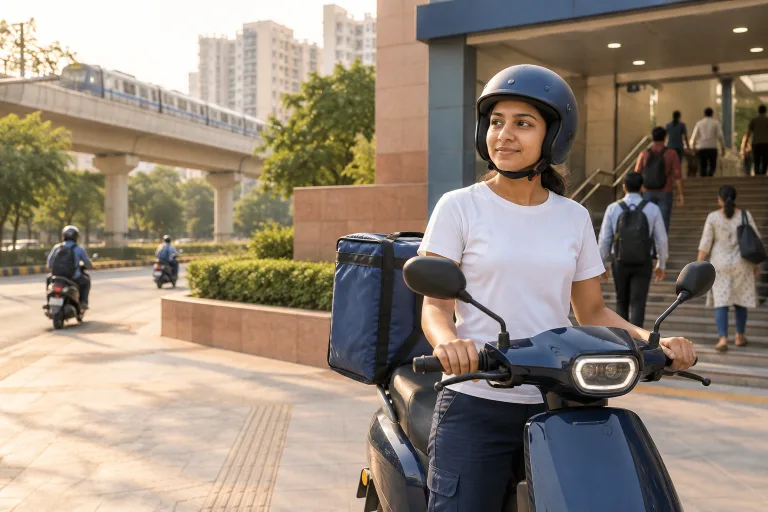
The 2025 and 2026 studies we read that count women in delivery riding all land in the same place: women are under 1 per cent of two-wheeler delivery riders in India. The reasons the reports give are practical ones: money to buy a vehicle, gaps in digital banking, long working weeks with few breaks, and doorsteps at night. Below is each report with its date and what it actually measured, a day in the life of a woman rider in East Delhi, and what the 2026 social security rules mean for women. For which companies take women riders, see delivery jobs for women in Delhi NCR.
The reports at a glance
| Report | Published | Who it covered | What it found about women |
|---|---|---|---|
| IDinsight phone survey | March 2025 | 2,547 two-wheeler delivery riders; more than half in big metros such as New Delhi and Bangalore | Less than 1% women; women respond to surge pricing less often than men (12% vs 22%) |
| NBER working paper 35467 | July 2026 | Drivers on major two-wheeler platforms in India and Indonesia, survey plus platform data | Female participation 0.8% in India |
| ILO–NCAER policy brief | August 2026 | Women in India's platform economy | Less than 1 per cent of two-wheeler delivery drivers are women (citing a study); 52 per cent of women lack capital to enter platform work vs 40 per cent of men (CGAP, 2022) |
| Redseer, reported by People Matters | August 2026 | India's gig workforce | More than 90% of monthly active gig workers choose part-time; female participation "relatively low" |
| HeatWatch 2026, reported by iSignal | October 2026 | Women gig workers (sample not stated) | 71% worked all seven days in summer; 65% had one break or none in a working day |
Each row's source is linked in the sections that follow.
How few, and why
The counts. IDinsight's survey of 2,547 riders found "less than 1% of women engaging in this kind of work" (IDinsight, 24 March 2025). A National Bureau of Economic Research paper, using survey and administrative data from major two-wheeler platforms, puts female participation at 0.8% in India (NBER, July 2026). The ILO–NCAER brief quotes a study of urban two-wheeler delivery drivers in which women made up under 1 per cent and the average driver was 28 years old (ILO–NCAER policy brief, August 2026).
Money for the vehicle. The same brief says women need start-up capital to buy a two-wheeler, and cites CGAP data from 2022: 52 per cent of women lacked the capital for platform entry, against 40 per cent of men. It also notes that in 2022-23 about 25.2 per cent of women could do online banking, against 47.1 per cent of men (brief above; ILO news release, 24 August 2026).
One company's fix for the vehicle problem. In the same brief, Even Cargo reports that since 2022 its loan-risk programme has helped 4,240 women delivery workers across eight cities get scooters: 78 per cent used it for the security deposit on a rented scooter, and 22 per cent (about 933 women) for a down payment on buying one. These are the company's own figures, as quoted in the brief.
Fewer peak bonuses. On surge pricing, IDinsight's figures are 12% for women against 22% for men: women reported reacting to it much less often, a gap the researchers tie to lower earning potential (IDinsight, link above).
Long weeks and few breaks
A 2026 HeatWatch report on gig workers found that 71% of the women surveyed worked all seven days of the week during summer, and 65% had only one break or none during the working day. Nearly 36% reported feeling faint or fainting, and 69% cut down or stopped work because of heat-related illness (iSignal, 14 October 2026). The article covers women gig workers in general, not only riders, and doesn't give the sample size.
In Delhi, a May 2026 Newslaundry report said many women gig workers "do not even have the basic dignity of taking a break or finding a toilet" (Newslaundry, 11 May 2026).
One rider's day in East Delhi
Question of Cities followed Lata Bharadwaj, a Zomato rider in East Delhi, for a day. She usually works between 12 noon and 11 pm. That day she did 20 orders and earned Rs 1,216, which she said is her daily average. In nine hours the reporter found one public toilet, a municipal one in Preet Vihar; otherwise riders look for a petrol pump or ask at restaurants. She also described refusing a late-night doorstep delivery to men who seemed drunk while she was working for Swiggy, after which her ID was blocked (Question of Cities, 1 May 2026). One rider's day, not an average for Delhi.
What companies say about themselves
- Zomato's count: by the company's figures, more than 3,500 women were active as its delivery partners in March 2026, and together they delivered over 500,000 orders a month (afaqs!, 7 March 2026). Back in June 2021, women were about 0.5% of its delivery partners (Business Today/PTI, 25 June 2021).
- Rest days and insurance: for Zomato and Blinkit, Goyal listed two rest days a month with pay for women partners, and maternity insurance of up to ₹40,000 within the cover the company pays for (January 2026) (Business Today, 2 January 2026).
- A higher estimate: in September 2024 Zomato's chief sustainability officer said women "account for less than 10% of the overall delivery workforce" (ETV Bharat/PTI, 27 September 2024). That is a company estimate; the independent studies above, which counted riders, found far lower shares.
What the 2026 social security rules give women
The new national rules for gig workers, the Social Security (Central) Rules 2026, apply from 8 May 2026. To qualify for benefits you need at least 90 days of work for one aggregator, or 120 days if you add up several, in the financial year before, and any day with any income counts. The Code lists health and maternity benefits among what schemes for gig workers should cover, but as of May 2026 no scheme had been notified under Section 114, and the one benefit announced so far, health cover under Ayushman Bharat, was still not available to platform workers (MediaNama, 12 May 2026). So as of May 2026 the national rules had not yet put a maternity benefit in place for gig workers; the maternity insurance above is something a company says it provides. How to register: gig workers' social security and e-Shram.
What this means if you are thinking of starting
- Expect to be one of few women at your hub or store, and plan your area and hours for that.
- Sort out the vehicle money first: our EV rental guide covers renting instead of buying.
- Keep your own record of days worked, for the 90-day count.
- Save the women's helplines in safety for women riders in NCR.
Want to try rider work?
Start with one short form: name, phone, city and area.